Complimentary Discovery Soap on Orders $50+ | 🇨🇦 Shipping Included in Canada on Orders $150+
What makes a soap truly luxurious and nourishing? At Soap Therapy, every bar is a blend of science, artisan skill, and mindful ingredient selection. Using extra-virgin, certified organic oils and fats, carefully calibrated superfatting, and botanicals and essential oils packed with bioactive compounds, each bar supports the skin’s natural resilience.
The chemistry of saponification, triglycerides, and unsaponifiables, combined with extended curing, creates creamy lather, gentle cleansing, and long-lasting performance. Unlike industrial products full of synthetic detergents and fragrances, Soap Therapy bars are designed to nourish, protect, and delight the senses, transforming a daily routine into a moment of thoughtful, science-backed luxury.
At Soap Therapy, luxury is defined not by excess or complexity, but by a deliberate return to simplicity. Luxury cold process soap reflects an understanding of what is essential, allowing thoughtfully chosen ingredients and careful formulation to speak for themselves. Scientific knowledge guides each decision, while artisan restraint preserves balance and intention. This philosophy is not new; it echoes earlier traditions when soapmaking was shaped by patience, observation, and time rather than speed or scale. By revisiting these foundational principles, modern luxury soap quietly reconnects contemporary formulation science with the origins of the craft.
Soapmaking is best seen as a discovery, arising wherever fats, water, and alkali naturally combined. Early evidence comes from Babylonian records of fat-and-ash mixtures, while ancient Egyptians used similar preparations for textiles and personal care. In Roman times, soap-like substances were primarily used for medicinal and textile purposes, with bathing relying on oils and strigils. By the medieval period, soapmaking had become a refined craft across Europe and the Mediterranean, shaped by regional oils and plant ashes. These historical methods were slow, observational, and material-driven, in contrast to modern industrial production, which prioritizes speed and efficiency, often overlooking the patience and care that defined traditional soapmaking.
At Soap Therapy, luxury means focusing on what is essential, selecting certified organic ingredients and processes that maximize skin nourishment rather than mass-market appeal. Our bars feature organic, extra-virgin, unrefined oils and fats, single scent notes, short ingredient lists, thoughtfully balanced superfatting, and longer-than-average curing times. True luxury also recognizes that the benefits and nourishment from natural organic soap develop gradually with regular use, rewarding patience and consistency. Each element is chosen to let the natural properties of the ingredients perform without interference, reflecting both artisan care and scientific precision.
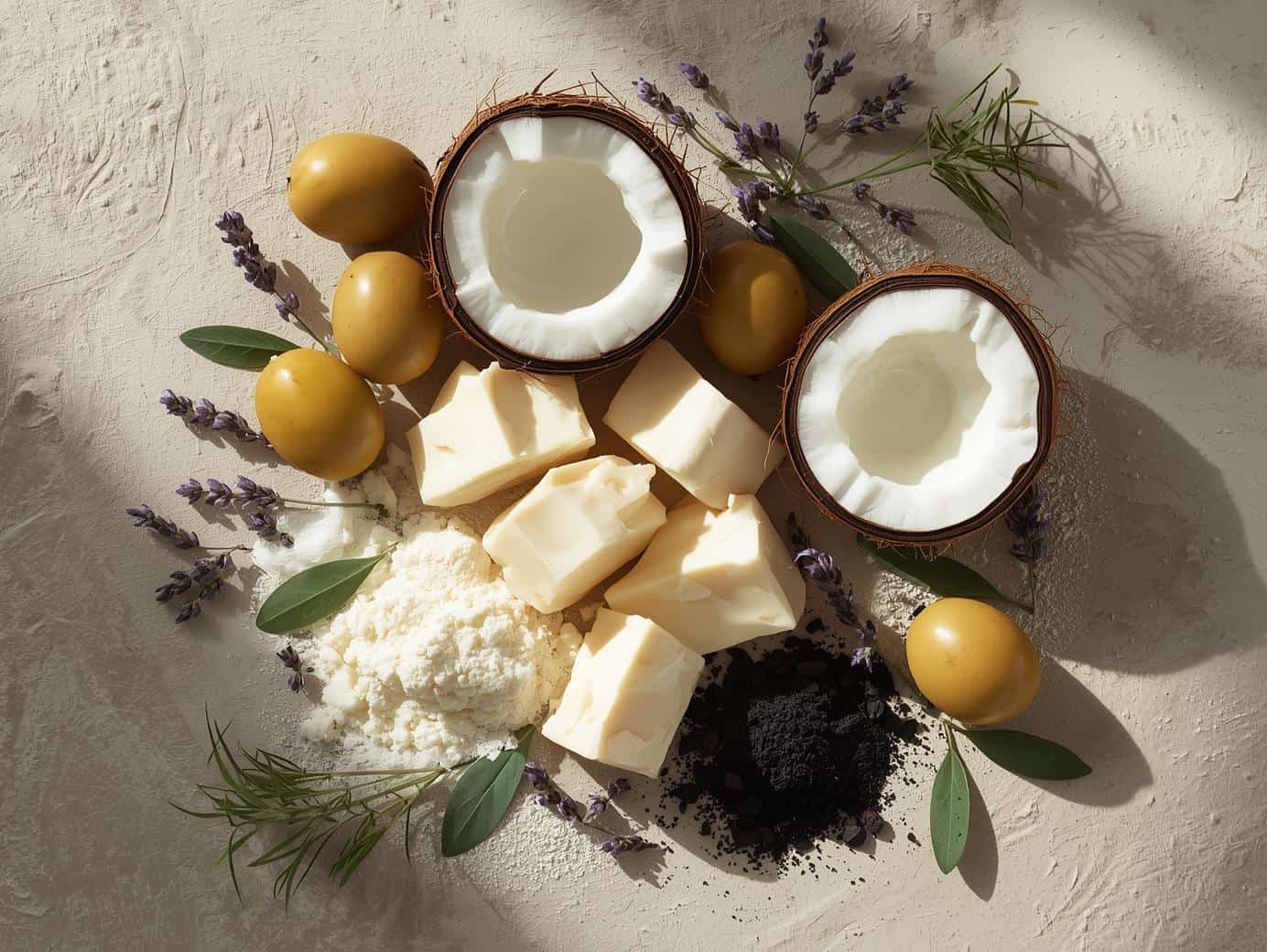
Our formulas combine oils and fats chosen for their functional properties and sourced from the lands where they are native: olive from Spain and castor from India provide conditioning and structure, while coconut from the Philippines and shea from Ghana, both certified fair trade, contribute hardness, lather, and emollience while supporting fair wages for workers. Keeping these ingredients extra-virgin and unrefined preserves unsaponifiables such as sterols, tocopherols, and carotenoids, which support hydration and skin barrier function. A small amount of citric acid is added as a chelating agent, binding heavy metal ions in hard water and preventing soap scum.
The soap forms through the reaction of sodium hydroxide and distilled water with the oils and fats, producing soap molecules and glycerin, a natural humectant. Certified organic botanicals and essential oils, exclusively extracted through steam distillation, are carefully chosen for their functional benefits and contribution to each formula. These ingredients provide polyphenols, flavonoids, and aromatic compounds that enhance skin health and sensory appeal. You can explore our shop to learn how each product is designed for a specific purpose. Through precise formulation, gentle mixing, and controlled curing, the final bar is mild, nourishing, and creamy.
The oils and fats used at Soap Therapy are predominantly composed of triglycerides, molecules formed by three fatty acids esterified to a glycerol backbone. Olive oil contains primarily oleic acid (approximately 70%), with smaller amounts of palmitic (10–15%), stearic (3–4%), and linoleic acids (10%), providing a soft, conditioning bar. Castor oil is rich in ricinoleic acid (about 90%), which increases lubrication and contributes to creamy, stable lather. Coconut oil contributes lauric (45–50%), myristic (18–20%), and palmitic acids (9–10%), supplying hardness and abundant bubbly lather, while shea butter’s stearic (30–35%) and oleic acids (45–50%) enhance conditioning, bar density, and creaminess. Together, these triglycerides dictate the bar’s cleansing profile, firmness, lather quality, and emollience, forming the structural and functional foundation of luxury soap.
Each oil and fat also contains unsaponifiables, minor components such as sterols, tocopherols, and carotenoids, typically ranging from 0.5–1.5% in coconut and castor, 1–2% in olive, and 3–5% in shea. These compounds resist alkaline hydrolysis during saponification due to their non-esterified structures and relatively low polarity, allowing them to remain chemically intact in the finished soap matrix.
Upon application, the amphiphilic nature of residual glycerides and the low molecular weight of sterols and tocopherols facilitate their partitioning into the stratum corneum lipids. Carotenoids, being lipophilic antioxidants, integrate into cellular membranes, scavenging reactive oxygen species and stabilizing lipid bilayers. Even at small concentrations (0.5–5%), these unsaponifiables are sufficient to maintain barrier function, prevent transepidermal water loss, and enhance skin resilience, contributing to long-term structural and biochemical skin health. It is important to note that these beneficial compounds are preserved only in extra-virgin, unrefined oils and fats, highlighting the necessity of selecting high-quality ingredients for luxury soap.
Saponification is the central chemical reaction in cold process soapmaking, where triglycerides in oils and fats react with sodium hydroxide to form sodium salts of fatty acids (soap molecules) and glycerin, a natural humectant. Sodium hydroxide (NaOH), commonly known as lye, is an alkali typically produced through the electrolysis of sodium chloride solutions. When dissolved in water, NaOH dissociates into hydroxide ions, which attack the ester bonds of triglycerides, cleaving them into fatty acid salts and glycerol. This reaction is exothermic and requires careful monitoring of temperature, concentration, and mixing to ensure complete saponification without degrading the oils or creating unreacted caustic residues. Extreme caution must be exercised when handling NaOH, as it is highly caustic and can cause severe chemical burns; proper protective equipment and precise measurement are essential.
Maintaining a carefully calibrated superfatting level is equally critical for both chemical and sensory outcomes. Too little superfatting can leave residual lye unreacted, producing a harsh, drying bar, while too much superfatting results in excess free oils that make the bar soft, greasy, and structurally unstable. Thoughtful superfatting preserves beneficial unsaponified oils that remain bioactive, supporting skin barrier function, hydration, and emollience. The level of superfat must be tailored to the fatty acid profile of the oils used: high-linoleic oils may require lower superfatting to maintain hardness, olive oil benefits from slightly higher superfat for conditioning, and coconut oil requires higher superfatting due to its high cleansing power to prevent dryness. By precisely balancing superfatting, luxury cold process soap achieves an optimal combination of mildness, moisturizing properties, and creamy, stable lather.
Botanicals and essential oils in Soap Therapy bars are certified organic and carefully incorporated to provide both functional and sensory benefits. These plant-derived compounds contain bioactive constituents such as polyphenols, flavonoids, terpenes, and aromatic molecules that contribute to antioxidant, anti-inflammatory, and antimicrobial activity. For example, lavender essential oil contains linalool and linalyl acetate, which reduce oxidative stress, promote skin barrier stability, and provide a calming scent profile. Eucalyptus essential oil is rich in eucalyptol and α-pinene, compounds known for their anti-inflammatory and mild antimicrobial effects, while also imparting a refreshing and invigorating aroma. The selection of each botanical and essential oil is guided by both its chemical efficacy and its contribution to the olfactory experience of the bar. Unlike luxury soap, many industrial bars substitute plant-derived compounds with synthetic analogs produced via petroleum modification for cost-effectiveness, which not only lack the nuanced bioactivity of natural extracts but can also potentially harm the skin.
During use, these bioactive compounds partition into the outer layers of the skin, interacting with lipids and cellular structures to deliver functional benefits. Polyphenols and flavonoids act as free radical scavengers, protecting membranes and proteins from oxidative damage, while terpenes can modulate local inflammatory responses. The cumulative effect of these ingredients supports hydration, barrier integrity, and skin resilience, reinforcing the nourishing qualities of luxury cold process soap. Readers interested in the specific applications of each botanical and essential oil can explore the shop to understand the purpose behind every formula.
Curing is a critical phase in cold process soapmaking, during which bars mature chemically and physically. Water gradually evaporates from the soap, concentrating the sodium salts and promoting crystallization of soap molecules, which enhances hardness and longevity. Saponification—the conversion of triglycerides into soap molecules and glycerin—is largely complete within the first 48–72 hours, ensuring that no unreacted alkali remains. The subsequent curing period allows the bar to lose excess water, stabilize pH, and develop its crystalline structure, improving lather quality, creaminess, and mildness. At Soap Therapy, bars are cured for at least 2 months, extending the typical curing period to ensure superior performance, optimal texture, and a more refined sensory experience. This extended approach reflects a philosophy of patience and precision, reinforcing the nourishing and luxurious qualities of each bar.
Industrial “cleansers” labeled as soap are typically composed of synthetic detergents and complex additive blends rather than true saponified fats. These detergents (e.g., sodium lauryl sulfate and related sulfonates) are petrochemical‑derived molecules designed for rapid foaming and intense lipid removal. Big industries favor synthetic detergents because they are cheap to produce, highly stable, and create abundant lather quickly, which appeals to mass-market consumers seeking an immediate “clean” sensation. Additionally, these detergents can be formulated at neutral or slightly acidic pH, which feels milder on the skin during use, even though they still strip essential lipids. Unlike the fatty acid salts in true soap, many of these compounds can disrupt the stratum corneum lipid barrier, provoke chronic irritation, and increase transepidermal water loss over time. Scientific literature documents these effects and highlights the risks of long-term exposure.
Beyond detergents, industrial formulations often include long lists of synthetic fragrance chemicals hidden under generic labels such as “fragrance” or “parfum.” These blends can contain thousands of compounds, some linked to endocrine disruption, respiratory irritation, and potential carcinogenic effects. Certain synthetic musks, for example, are persistent in the environment and may pose carcinogenic risks. Because these ingredients are chosen for cost and scent longevity rather than compatibility with skin biology, they can confuse cutaneous signaling pathways and aggravate hypersensitivity. In contrast, luxury cold process soap uses saponified oils, extra-virgin fats, and natural essential oils, providing gentle cleansing while supporting hydration, barrier function, and long-term skin health.
At Soap Therapy, luxury is defined not by excess, but by restraint, knowledge, and a commitment to simplicity. Every bar is crafted using extra-virgin, certified organic oils and fats, carefully balanced superfatting, and thoughtfully selected botanicals and essential oils. The focus is on skin nourishment, gentle cleansing, and a creamy, satisfying lather that develops fully only with patience and time. By understanding the science behind saponification, unsaponifiables, and curing, luxury soap becomes an experience where function, elegance, and safety converge.
We encourage readers to read the labels of commercial products and appreciate the difference in quality. Each Soap Therapy bar reflects careful craftsmanship, scientifically informed formulation, and a commitment to the planet, using clean, sustainable ingredients that support both skin health and environmental responsibility. Every bar transforms a simple daily ritual into a sublime moment of sensory pleasure, mindful indulgence, and enduring respect for nature.
CATEGORIES