Complimentary Discovery Soap on Orders $50+ | 🇨🇦 Shipping Included in Canada on Orders $150+
The story of the unsaponofiables continues. While this term technically refers to the compounds found in carrier oils that do not react with lye, our definition encompasses any ingredient in our bars that does not react with lye. Those ingredients play an important role in providing the healing and nourishing experience that the skin is looking for. Explore the benefits of our unsaponified ingredients in our bars and learn why Soap Therapy is different.
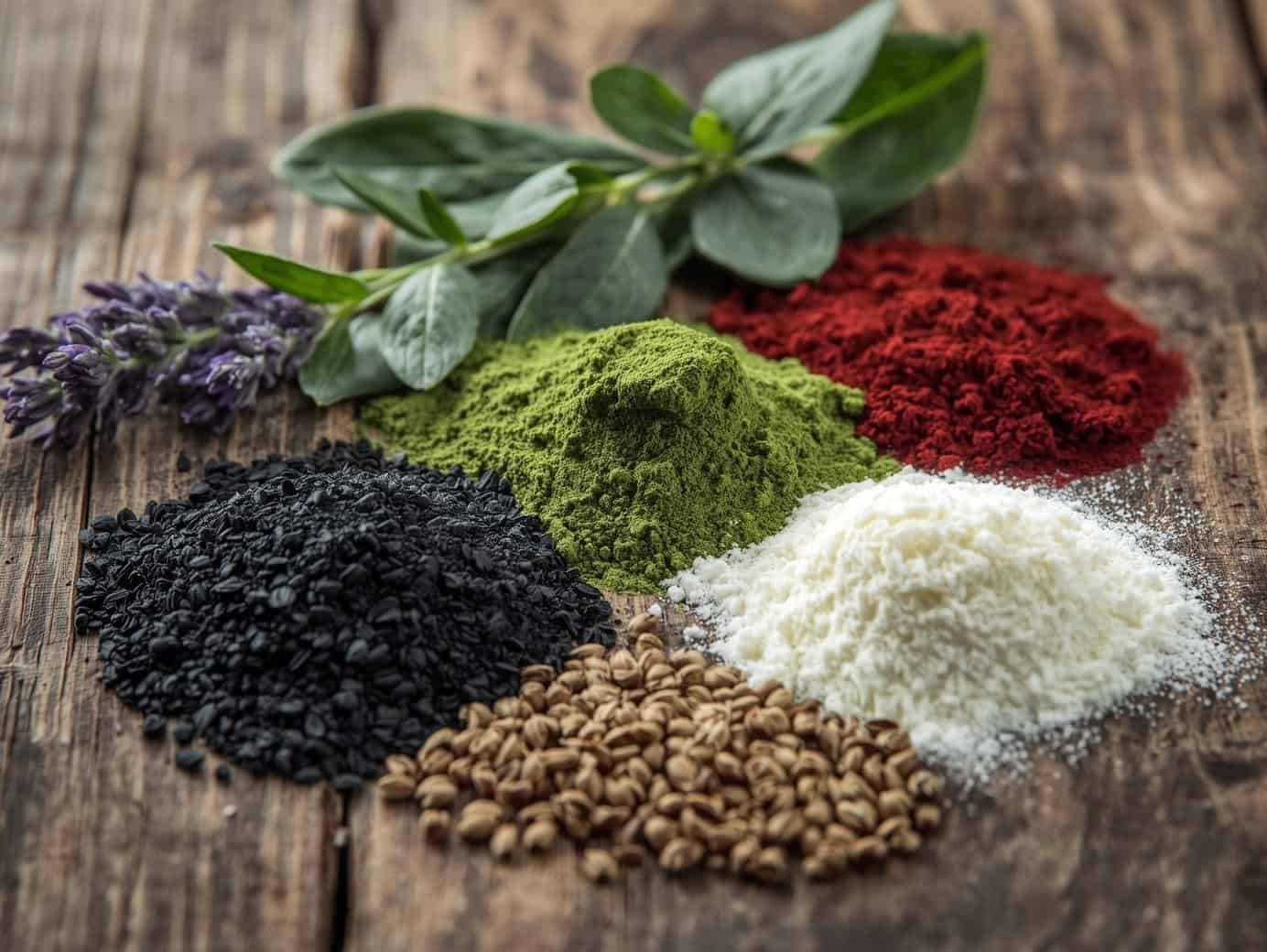
Unsaponifiables are mostly recognized as the natural chemical compounds found in unrefined fats or extra virgin oils. They do not participate in the saponification process. They are present, observing the triglycerides interacting with lye, forming soap molecules. In our cold process technique, low temperatures do not destroy unsaponifiables, as they often are heat-sensitive. However, in the context of our discussion, we will expand the definition of unsaponifiables to include Soap Therapy’s signature add-ons that provide increased skin nourishment elevating each ritual. In Part 2, we will discover the benefits of Eucalyptus essential oil and Chlorella Powder in Flare; Activated Charcoal and Aniseed in Rive; Goat Milk powder and Chamomile in Wellborn; Lavender essential oil and Madder Root powder in Gloam.
The Eucalyptus essential oil present in Flare is obtained from Eucalyptus Globulus trees, one of the many species that form the genus of Eucalyptus trees. It is a very old tree, dating back to millions of years and native to Australia. In the 1800s, it was believed that the aroma of Eucalyptus cured Malaria when in fact it was later realized that Eucalyptus was so thirsty that it drained the breeding grounds of malaria-infected mosquitoes.
A Eucalyptus tree can reach a height of 70 meters living anywhere from 200 to 500 years. The tree, under normal circumstances, produces leaves all year round and is therefore not seasonal. Each tree can produce around 10 kilograms of fresh leaves per year. With a yield of around 2%, each tree therefore returns about 200 ml of essential oil through steam distillation.
The essential oil is dominated by Eucalyptol which accounts for up to 85% of the composition. The rest is primarily alpha-Pinene and Limonene (monoterpernic hydrocarbons). When inhaled during a morning shower, Eucalyptol acts as a decongestant, a cough suppressant, and most importantly improves mental focus through a combination of biological and neurological mechanisms.
Chlorella powder comes from a single-celled green alga, a microscopic organism that thrives in sunlit freshwaters. While the alga has existed for over a billion years, a scientist intentionally discovered it in the late 19th century under a microscope. In mid 20th century Japan, its magnetic properties were discovered; powerful enough to attract heavy metals such as lead and mercury. The extraction of the powder undergoes mechanical processes only, like sedimentation, centrifugation, milling and pressurizing. To extract 100 grams of Chlorella powder, one needs a volume of up to 700 litres of freshwater. Chlorella powder is almost 60% proteins, containing all 9 essential amino acids that the human body can not produce on its own – a rarity in the world of plants. The Chlorella Growth Factor (CGF) helps with cellular regeneration, collagen protection, and detoxification. Chlorophyll, another compound, acts as an anti-inflammatory and antibacterial agent.
In the late 1800s, activated Charcoal was prepared from coconut shells and it was studied for its ability of adsorbing gases and effective air filtration. The charcoal we use is food grade and comes from coconut shells. It is superior because of a high concentration of micropores, making it very effective at trapping small molecules. The activation of charcoal is the process of removing tars and resins to create a massive network of microscopic pores.
It wasn’t until the 21st century that the use of activated charcoal surged in soap making. It is a deep pore cleanser and pollution removal. It is highly effective at pulling excess oil from the skin’s surface, hence why Rive is recommended for oilier skin. It can also physically trap bacteria that can cause body odour, effectively acting as a deodorizer.
Aniseed is one of the world’s oldest known medicinal plants. It is native to the Mediterranean and the Middle East. It has been (and still is) used to comfort bowel movements. At Soap Therapy, we use ground aniseed to complement activated charcoal in its odour neutralization and antiseptic properties. It also adds a level of exfoliation, helping in the removal of dead skin cells when applied directly to the skin. Ground aniseed also contains minerals such as Iron, Manganese, Calcium that help soothe the skin.
Goat milk has been used in soap making for millennia. It is believed that Cleopatra used to bathe in goat and donkey milk to preserve the youthfulness of her skin. In ancient Rome, goat fat was used to create early soap bars. Liquid goat milk has been a staple ingredient in the common era. However, a major challenge is its scorching when combined with lye. There are some workarounds. However, goat milk powder has great advantages. While some nutrients may be lost through the dehydration process, a lot of beneficial compounds end up getting concentrated. Lactic acid simultaneously exfoliates dead skin cells and hydrates the new layer underneath. It stimulates the production of ceramides – major component of the skin barrier. It can help support skin conditions such as Eczema, Psoriasis through its powerful anti-inflammatory properties.
Like Aniseed, Chamomile is also one of the more ancient medicinal herbs. In ancient Egypt, Chamomile was dedicated to Ra – the sun god. In medieval times, the anglo-saxons included Chamomile as one of the nine sacred herbs. In the middle ages, before hops were used, Chamomile provided the needed bitterness in brewed beer. At Soap Therapy, we use ground dried chamomile flowers. Other than providing a natural exfoliation experience, it can help in redness reduction and Eczema support through its powerful anti-inflammatory agent: Bisabolol. It can also help with anti-aging and cell regeneration through its flavonoids: Apigenin and Luteolin.
The Lavender essential oil present in Gloam is extracted from Lavendula Angustifolia. Lavender has been utilized by humans for more than 2000 years: a base for high end perfumes in ancient Egypt mummification, for bathing and laundry in Ancient Greece and Rome. The steam distillation process of obtaining the essential oil only started in the 16th century. The plant is native to Southern Europe and North Africa.
There are two primary compounds in lavender essential oil: Linalyl Acetate, and Linalool. The former is converted to the latter during the saponification process. As you inhale Linalool molecules, they bind to your olfactory receptors, and electric signals are sent to the limbic system; a system that manages emotions, memory and heart rate. Once in the brain, it mimics the effect of anti-anxiety pills. The experience will help with rapid stress reduction, and sleep preparation.
Madder root powder is extracted from the underground roots and rhizomes of Rubia Tinctorum, commonly known as Dyer’s Madder. To produce a high-quality pigment, the roots must grow for at least 3 years before being cultivated. The plant is native to Eurasia. It is currently grown primarily in Turkey, India, and Iran. In Ayurvedic medicine, Madder root is used for blood purification, and lymphatic support, as well as skin brightening and female reproductive health.
When used regularly in soap bars, it can help fade dark spots due its Anthraquinones. It also helps killing acne-causing bacteria. It creates a gentle micro-exfoliation experience, and acts as an environmental shield, protecting the skin against premature aging.
The benefits of Soap Therapy extend far beyond the needed regular cleansing. Every ingredient we use in all of our bars has a purpose. Every ingredient plays a role in supporting the skin, healing it and nourishing it. Every ingredient is a word you can pronounce and you can spell. If you haven’t picked your bar yet, you are encouraged to start your journey with us. If you have been practicing Soap Therapy, remember that the impact is often not immediately seen but instead realized over time. Soap Therapy is only one part of a holistic approach to skincare. We encourage you to tackle all aspects of the living experience to create a happier and healthier self.
CATEGORIES